The Agentic Commerce Revolution: How to Capture the $5 Trillion Opportunity in Latin America
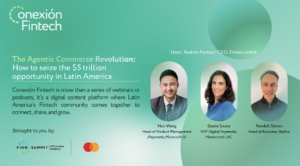
Fintech Connection is more than a webinar or podcast series. It is a digital content platform where Latin America’s Fintech community comes together to connect, share, and grow.
Co-produced by Finnosummit and Mastercard, this initiative is designed to foster meaningful conversations around critical topics, including innovation, entrepreneurship, and financial sustainability across the region.
In the third episode—now available on video—we were joined by:
-
Hao Wang, Head of Product Management, Microsoft
-
Randall Davies, Head of Business, Skyfire
-
Guida Sousa, SVP Digital Payments LAC, Mastercard
Our CEO, Andrés Fontao, served as Host of this Fintech Connection series.
The conversation explored one of the most structurally transformative shifts facing the financial ecosystem: the transition toward Agentic Commerce.
More than a user experience enhancement, agentic commerce introduces a new operational layer—autonomous agents capable of executing financial decisions through programmable delegation.
For Latin America, this represents a strategic opportunity. But it also presents a profound challenge in infrastructure, governance, and trust.
The Three Agentic Commerce Models
There are three primary architectures emerging.
1. Agent-to-Site
This is the model closest to today’s commerce. An agent navigates a merchant’s website as a human would—searching for products, clicking, adding to cart, and completing checkout.
It is intelligent automation layered onto existing infrastructure, without fundamentally transforming the underlying payments system.
2. Intermediated Agent-to-Site
Here, a trusted intermediary plays a central role. For example, Microsoft Copilot can understand user intent, discover products on their behalf, curate inventory, and facilitate checkout within the same platform.
This model introduces an institutional trust layer.
From Microsoft’s perspective, this architecture holds the strongest immediate potential in Latin America. Why? Because scaling in the region depends on two structural factors:
-
Trust
-
Infrastructure
In markets where digital fraud remains a significant concern, consumers and merchants are not yet ready to delegate payments directly to any autonomous agent without institutional backing.
3. Agent-to-Agent
This is the most advanced and future-facing model. A consumer’s AI assistant negotiates directly with a merchant’s agent. They exchange structured data, validate inventory, and execute transactions autonomously.
It is efficient and elegant—but requires maturity in digital identity, delegated authorization, and protocol standardization.
“AI will automatically track inventory and place orders on your behalf. More importantly, AI could find a coupon for you if milk goes on sale. The discovery phase will change; however, settlement, backend systems, and financial rules (banks, credit card clearing) will remain. Instead, the process will be faster and more convenient for the user. In the future, you’ll have multiple agents: one for shopping, one for travel, another for restaurant reservations.”
— Hao Wang, Head of Product Management, Microsoft
From User Experience to Structural Infrastructure
Agentic commerce does not eliminate traditional financial infrastructure.
Authorization.
Clearing.
Settlement.
Risk management.
These remain essential.
Innovation is occurring in the discovery and decision layer. Responsibility remains anchored in financial infrastructure.
-
Microsoft enables discovery and intent.
-
Mastercard ensures secure settlement through tokenization and advanced authentication.
-
Skyfire introduces verifiable identity for agents.
The system evolves—it does not disappear.
Infrastructure, Delegation, and the Emergence of “Know Your Agent” (KYA)
Agentic commerce elevates financial infrastructure rather than replacing it. As the Fintech sector in Latin America now captures 46% of total tech venture capital investment, innovation is shifting toward the discovery and decision layer.
The fundamental shift is programmable delegation.
To secure this process, Randall Davies introduced the concept of Know Your Agent (KYA). As Davies explained, real utility will arrive when agents “not only recommend, but act, transact, and optimize autonomously on behalf of consumers or businesses.”
Tokenization and Authentication as Anchors of Trust
Guida Sousa emphasized that, for this model to work in Latin America, security must be structural.
“All transactions must be tokenized, as this brings significant security and fraud reduction,” Sousa noted.
She also highlighted asymmetric ecosystem readiness:
“In Latin America, the vast majority of issuers are already prepared… the gap lies more on the acceptance and acquiring side.”
Programmable Wallets and the Evolution of Risk
Agents operate through bounded wallets that include:
-
Tokenized funding sources
-
Predefined authorization rules
-
Detailed transaction logs
-
Immediate suspension capabilities
Issuers will maintain their authorization engines. However, they must evolve to distinguish between:
-
Direct human behavior
-
Authorized machine-to-machine activity
This opens a new frontier in fraud analytics sophistication.
Protocols and Interoperability
We are currently in an early development stage where multiple emerging protocols coexist. This is not a winner-takes-all market.
The strategic position is clear: the future will be built on openness, interoperability, and a layered ecosystem architecture. While standardization will emerge organically over time, the immediate priority is enabling continuous innovation without slowing technological adoption.
Regulatory Implications
Institutions face new requirements:
-
Transparency in automated decision-making
-
AI model oversight
-
Explainability
-
Agent risk management
While fully autonomous regulatory agents are not yet standard in the region, assisted compliance automation represents a clear opportunity.
Adoption will be progressive—and human-supervised.
A Preparation Roadmap for Latin America
Building “agent-ready” infrastructure requires:
-
API modernization
-
Broad tokenization penetration
-
Advanced authentication (biometrics, passkeys, FIDO)
-
KYA frameworks
-
Risk model adaptation
-
Governance integrated from design
A 3–5 year consolidation window aligns with historical payment adoption cycles.
Conclusion
Agentic commerce does not replace financial infrastructure. It elevates it.
As highlighted by the experts in Episode 3 of Fintech Connection, trust, identity, and security become even more critical in an environment where AI agents execute autonomous decisions.
In Latin America, the intermediated model—backed by strong infrastructure, verifiable identity, and robust tokenization—will likely serve as the entry point to mass adoption. But the pace will depend on how prepared the ecosystem truly is.
Listen to the Full Episode
To dive deeper into the conversation with Microsoft, Mastercard, and Skyfire: