The Fintech ecosystem in Mexico has already reached a stage of maturity, as reflected in our most recent Finnovista Fintech Radar Mexico 2026. However, beyond the number of established Fintech companies or the massive adoption of Artificial Intelligence, one of the most revealing findings is the tangible impact of female leadership in the democratization of finance.
During this week of International Women’s Day, from Finnosummit we want to analyze how a gender perspective is transforming the financial sector. The data is clear: this is not only about parity, it is about business strategy and social impact that benefits everyone across Latin America, and particularly in Mexico.
From a general discourse to focused action
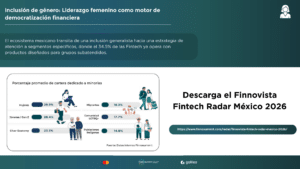
Historically, financial inclusion has been an overly broad concept. In 2026, we observe an evolution toward a strategy focused on specific segments. Currently, 34.5% of Fintech companies in Mexico already operate with products specifically designed for underserved groups.
What is interesting is who is leading this change. Mexican Fintech companies demonstrate a much deeper connection with the country’s social gaps: 46.2% of Mexican companies have this inclusive focus, compared to only 20.8% of foreign Fintech companies operating in Mexico.
This local leadership suggests that Mexican founders and leaders possess a far more precise understanding of the country’s social gaps, turning operational proximity into a competitive advantage.
The ‘female leadership effect’ in Mexico: The data point that changes everything
Perhaps the most critical discovery for sector governance is what we have called the “leadership effect.” The analysis of the Mexican Fintech ecosystem data in 2026 reveals a direct correlation: the presence of more than 50% women in leadership positions doubles the likelihood that a Fintech will develop inclusive solutions.
This “female leadership effect” demonstrates that diverse talent is no longer just a compliance metric, but has become the strategic engine driving penetration into previously ignored markets. Under this inclusive vision, the average Fintech portfolio dedicated to minority segments is distributed with a clear intention of impact: women lead this trend representing 28.9% of that portfolio, followed by the growing Silver Economy market with 23.3% and the migrant sector with 18.3%. In this way, diversity in leadership teams is reflected not only in internal culture but also in the company’s real ability to capture and serve specialized niches with high-value financial solutions.
Verticals leading the change
Contrary to the belief that inclusion is limited to basic credit products, the gender perspective is permeating sophisticated sectors. Verticals such as Wealth Management and Cryptoassets are at the forefront, where more than 70% of Fintech companies already prioritize minority sectors. This indicates that leaders in Mexico, particularly those who are part of DisruptHer, are not only seeking to provide access to an account, but also to foster long-term wealth creation and financial health.
At Finnosummit we are convinced that technology is an enabler, but people are the ones who define the direction. The data from the Finnovista Fintech Radar Mexico 2026 shows that to close inequality gaps in the country, we need more women in decision-making positions.
Diversity in leadership teams is not only an ethical matter, but also a competitive advantage that allows organizations to better understand the market and serve those whom the financial system has ignored for decades.